Fuel Frozen as the Clocks Go Back
The Chancellor's first Budget froze fuel duty and confirmed pay-per-mile for EVs, just as the darker evenings bring the riskiest fortnight of the year on the roads.
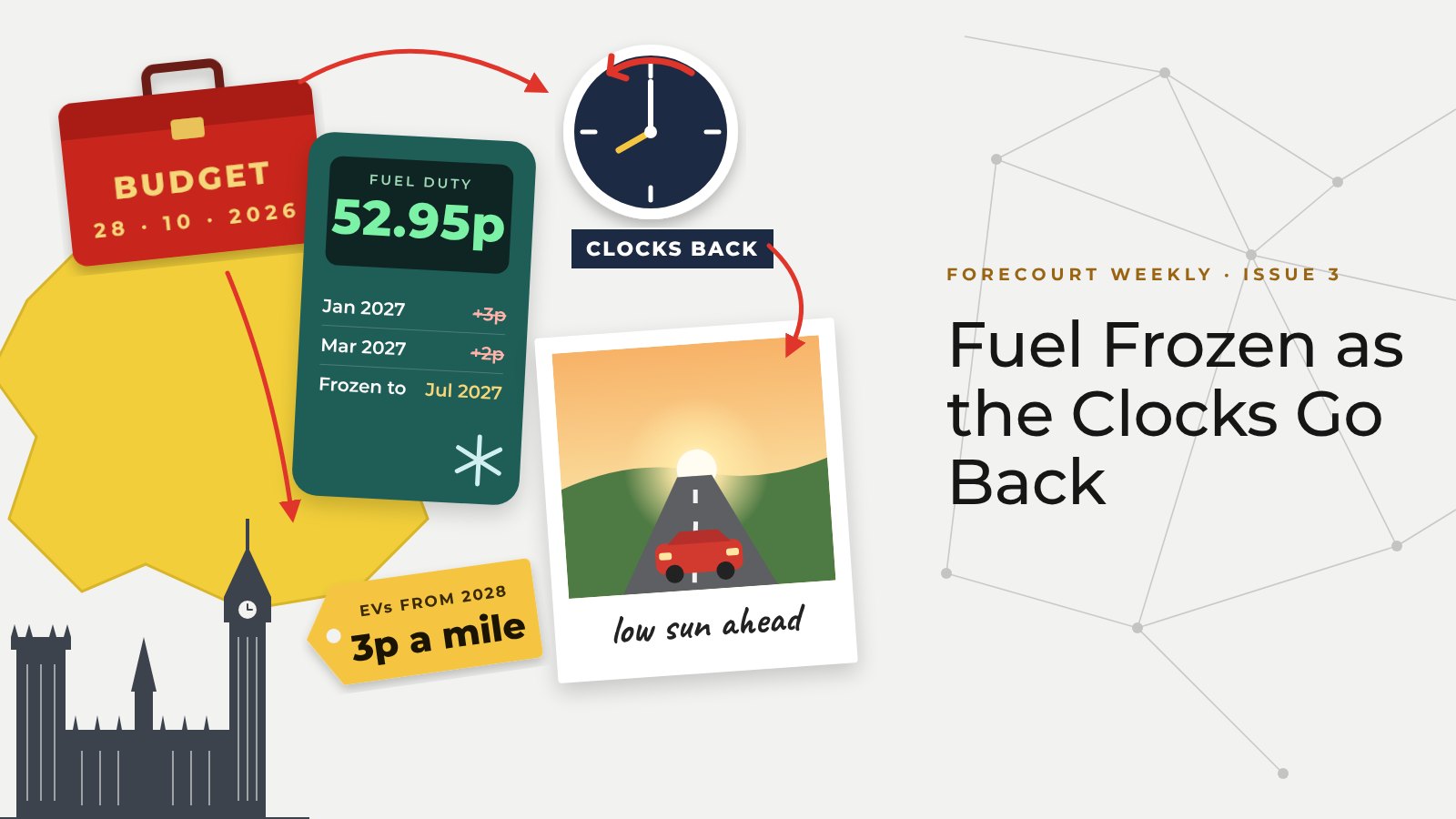
This week on the forecourt
Two things changed for drivers in the space of four days. On Sunday the clocks went back, and the drive home got darker overnight. On Wednesday the Chancellor stood up with his first Budget, and the big question was whether it would hit motorists in the pocket.
The short answer: less than many feared. Below, we go through what was actually announced rather than what was rumoured, what it means if you're buying a car in NI, and how to stay safe now that the low sun and long nights are back. Kettle on.
Lead story: what the Budget means for drivers
John Healey delivered his first Budget as Chancellor on Wednesday 28 October (RAC). In the run-up there was plenty of talk about new taxes on drivers. Here's what made it into the speech and the documents, as reported by the motoring press on the day.
| What | What was announced | When |
|---|---|---|
| Fuel duty | Stays at 52.95p a litre. The 5p cut is extended and the planned 3p and 2p rises are scrapped | Until July 2027 |
| Car tax (VED) | Rates rise in line with RPI inflation. New figures not yet published | April 2027 |
| Pay-per-mile for EVs (eVED) | Confirmed at 3p a mile for electric cars and 1.5p for plug-in hybrids | April 2028 |
| Company car tax | Every band rises by one percentage point; electric cars go from 9% to 10% | 2030/31 |
| Business mileage | 55p a mile for the first 10,000 miles made permanent; miles above that rise from 25p to 35p | 35p from April 2027 |
| Charging at home | VAT relief on household electricity extended | Until July 2027 |
| Charging in public | VAT stays at 20%, but £100m to cut costs at lower-powered public chargers | From spring 2027 |
Sources: PetrolPrices, RAC, Carwow, Auto Express, Express, Broker News.
Fuel: a freeze, not a cut. The temporary 5p cut was due to end in December. Instead it now runs to July 2027, and the 3p rise planned for 1 January and the 2p rise planned for 1 March won't happen. With VAT, that's about 6p a litre you won't pay, or roughly £3.30 on a 55-litre fill from March (PetrolPrices). There was no further cut and no change to VAT on fuel. The RAC said a freeze "only avoids making an already difficult situation worse" (RAC). What happens after July 2027 wasn't set out in the speech; Auto Express reports the cut is then due to be unwound in stages (Auto Express).
Car tax: up with inflation from April. VED will rise in line with RPI from April 2027, for almost every petrol, diesel and electric car (Express). The exact new rates haven't been published yet, so treat any figure you see quoted as an estimate for now.
Pay-per-mile is still coming. The charge for electric and plug-in hybrid cars, first announced last year, is confirmed for April 2028 at 3p a mile for EVs and 1.5p for plug-in hybrids. Drivers will be able to declare their mileage themselves or use a telematics option (Auto Express). On 10,000 miles a year, that works out at about £300 for an electric car and £150 for a plug-in hybrid.
The "heavy car tax" didn't appear. Days before the Budget, the Conservatives claimed the Chancellor was preparing a new tax on bigger, heavier cars, linked to a campaign group's proposal of £10 per kilogram on heavy new cars (Auto Express). None of the Budget coverage we've read reports any weight-based tax being announced. That could change in future Budgets, but it isn't policy today.
Company cars and EVs. Company car tax rates are now set out to 2030/31, with every band rising by one point. Taxing a £40,000 electric company car would cost a 40% taxpayer about £160 a year more than in 2029/30 (Business Motoring). EV salary sacrifice schemes got no long-term guarantee, which the industry called frustrating (Business Motoring). We haven't seen any report of changes to the Electric Car Grant, which is open to NI buyers and is worth up to £3,750 on eligible new EVs under £37,000 (Department for Infrastructure).
What it means in NI: fuel duty, VED and the business mileage rates are set UK-wide, so everything above applies here exactly as it does in GB. One thing to watch: the "£50 a year" saving quoted for the electricity VAT relief is based on Ofgem's GB price cap, which doesn't cover NI (Carwow), so what you save charging an EV at home here will depend on your supplier's tariff.
The Forecourt take: for most people buying a petrol or diesel car this winter, very little changes. If you're weighing up a used EV or plug-in hybrid, add a pay-per-mile line to your running costs from 2028, and factor it in when you compare prices.
Clocks back: why the next fortnight is the riskiest of the year
The clocks went back on Sunday 25 October, and the AA says crashes rise straight after. Its Accident Assist team handled 2,949 crash claims in the fortnight before last year's clock change and 3,178 in the fortnight after, a rise of almost 8% (Auto Express).
| Drivers who said… | Share |
|---|---|
| Low sun is their biggest autumn driving problem | 73% |
| Other drivers don't use their lights properly | 52% |
| Cyclists and pedestrians are hard to see in some conditions | 50% |
| They dislike driving in the darker mornings and evenings | 40% |
| They regularly see cars with faulty lights | 40% |
Source: AA survey, via Auto Express.
Tim Rankin, managing director of AA Accident Assist, called the rise "a timely reminder that drivers need to adapt as autumn takes hold" (Auto Express). The school run and the commute home now fall in the same low, blinding light, and on NI's country roads that can mean a dip, a bend and a tractor all at once.
Five things to do this week:
- Keep sunglasses in the car. A visor won't always block a sun sitting on the horizon.
- Clean the windscreen inside and out. Low sun turns every smear into glare. Top up the screenwash while you're at it.
- Walk round your lights. Check every bulb, and clean or restore hazy headlights.
- Leave a bigger gap. Wet leaves and the first frosts make stopping distances longer.
- Book that overdue eye test. Ask about anti-reflective coatings if modern LED headlights dazzle you.
Advice from the AA, via Auto Express.
Quick hits
- Hyundai Ioniq 5 is Used Car of the Year. It's the first electric car to win Auto Express's top used award, praised for its space, range and fast charging. Early cars start at around £13,000, and most should still have some of Hyundai's five-year warranty left (Auto Express).
- Chery wants to build cars in Britain. Its chairman says he wants cars "designed in the UK, engineered in the UK and produced in the UK", and Chery has already signed an agreement with Nissan about potentially using spare capacity at Sunderland. There's no timeline yet (Auto Express).
- A new Land Rover Discovery is on the way. JLR is turning Range Rover, Defender, Discovery and Jaguar into separate brands, and work on the next Discovery is "well under way", though there's no launch date yet (Auto Express).
- DVLA admits it hasn't met expectations. Its new business plan concedes some services "have not always met customer expectations" and promises AI help in its contact centre and quicker complaint handling (Auto Express). In NI, driving licences come from the DVA, but vehicle tax and logbooks are still handled by the DVLA.
Buyer tip of the week: viewing a car after dark
With the evenings drawing in, plenty of viewings will now happen after work, in the dark. That's actually a good chance to check things you'd miss in daylight:
- Every light. Dipped and main beam, fog lights, indicators, brake lights, reverse light and number plate light. Get the seller to press the brake while you stand behind.
- Headlight haze. Cloudy, yellowed lenses cut how far you can see. Restoring them isn't expensive, but it's worth knocking off the price.
- Heater and demister. Run the heater on full and the rear demister for a few minutes. A screen that won't clear on a cold night is a problem you'll live with all winter.
- Dashboard lights. Warning lights are easier to spot in the dark. Every one should come on with the ignition, then go out once the engine starts.
- Go back in daylight. Paint scratches, dents and mismatched panels hide in the dark. If you like the car, see it again in daylight before you hand over any money.
Sources and credits
Forecourt Weekly summarises and links to original reporting. All figures are credited to the outlets below; please read them for the full stories.
- PetrolPrices: Budget 2026, the 5p fuel duty cut stays until July
- RAC: Autumn Budget 2026, what it means for motorists
- Carwow: Autumn Budget 2026, fuel duty cut extended, mileage rates increased
- Auto Express: Autumn Budget 2026 for motorists
- Auto Express: Tories spark rumours of a heavy car tax
- Express: VED car tax changes from April 2027
- Broker News: Chancellor reveals new BIK rates
- Business Motoring: BiK to rise across all company car bands in 2030/31
- Business Motoring: Budget "disappointing" for those moving to cleaner mobility
- Department for Infrastructure: Grant scheme for zero emission vehicles
- Auto Express: Car crashes jump 8% when the clocks go back
- Auto Express: Used Car of the Year 2026, Hyundai Ioniq 5
- Auto Express: China's Chery plans to build cars in Britain
- Auto Express: New Land Rover Discovery
- Auto Express: DVLA admits it's not meeting expectations
Forecourt Weekly is for general information only and isn't financial, legal or insurance advice.